GitHub Integration - AWS CodeStar Connection
To use a GitHub repository as your pipeline's source, an AWS CodeStar (CodeConnections) connection needs to be established first. For more details see the GitHub connection page.
Quick Setup
Create the connection in the account where the pipeline will run:
aws codeconnections create-connection --provider-type GitHub --region ${AWS_REGION} --connection-name MyConnection
This initializes the connection from the AWS side. Go to the AWS CodeStar Connections console and finish the installation through the browser.
Note: The user completing this needs:
- Ownership permission on the GitHub Organization / Account
- IAM permissions on the account:
codestar-connections:ListConnectionscodestar-connections:CreateConnectioncodestar-connections:UpdateConnectionInstallation
Configuration
For the default (CODEPIPELINE) and CDK_PIPELINES engines, configure your pipeline with Repository.codestarConnection, passing the connection ARN from the step above — this is the one that actually works for those two engines. Plain Repository.github(name, branch) has no connectionArn, so the pipeline's source action fails to synthesize with a CodeStar connection ARN is required for a github source if you use it with either of these two engines:
import { defineCICD, Repository } from '@cdklabs/cdk-cicd-wrapper';

export default defineCICD({
  application: 'my-app',
  repository: Repository.codestarConnection('owner/my-repo', 'arn:aws:codestar-connections:region:account:connection/uuid', 'main'),
  stages: ['dev', 'prod'],
});
Repository.github(name, branch?) (no connection ARN) is only meaningful with the GITHUB_ACTIONS engine below — GitHub Actions checks out the source itself, so there is no CodeStar-connection source action to build.
GitHub Actions instead of an AWS-hosted pipeline
If you would rather render a .github/workflows/deploy.yml and let GitHub Actions run your pipeline (instead of AWS CodePipeline/CodeBuild), set engine: EngineType.GITHUB_ACTIONS — this requires repository to be Repository.github(...) (the workflow runs where GitHub already checked the source out):
import { defineCICD, EngineType, Repository } from '@cdklabs/cdk-cicd-wrapper';

export default defineCICD({
  application: 'my-app',
  repository: Repository.github('owner/my-repo'),
  engine: EngineType.GITHUB_ACTIONS,
  stages: ['dev', 'prod'],
  githubActions: {
    // roleName defaults to '<application>-github-role'; subjectClaims defaults to every
    // ref/environment of 'owner/my-repo' when omitted.
    // Configure required reviewers on the generated `prod` GitHub Environment first.
    environmentProtectionConfigured: true,
  },
});
cdk-cicd deploy-ci only deploys the OIDC role (GitHubActionRole) the generated workflow assumes — the workflow itself is what runs the pipeline once you push it. See the Autopilot pipelines workshop for a walkthrough.
GitHub workflow YAML can name an Environment but cannot create its required-reviewer protection rule.
When any stage resolves to manualApproval: true, rendering fails unless
githubActions.environmentProtectionConfigured is explicitly true. Set that flag only after the
matching GitHub Environments have required reviewers configured.
Current limitations:
APP_STAGINGis not supported by the generated workflow; useDEFAULTor deploy the application directly/local instead.- Caller-configured
deployRoleExternalId/deployment.externalIdvalues are rejected because the installed GitHub engine cannot forward them. This is separate from the dependency's fixed ExternalId described below. - A resolved deployment-role path or name cannot contain the literal
cfn-exec, including through the effective bootstrap qualifier, because the installed GitHub engine rewrites that segment todeploy. - Bootstrap prerequisite: the generated workflow's deploy step assumes the CDK deploy role with an explicit
ExternalId(acdk-pipelines-githubdefault, not something this wrapper controls). If your environment was bootstrapped with the current CDK CLI default (cdk bootstrap's--deny-external-id, enabled by default), that assume-role call is rejected outright and the deploy job fails. You need to either re-bootstrap without--deny-external-id, or allow-list exactly thatExternalIdon the deploy role's trust policy (a minimally-customizedcdk bootstrap --template, adding one statement, is enough — seefindings.json'smigration-github-actions-engine-deny-external-id-incompatibilityfor the exact shape). This is a real prerequisite, not an edge case — it will block your very first real deploy on a freshly-bootstrapped account.
Known Issues
- Careful if you see a page like this when you open the Console
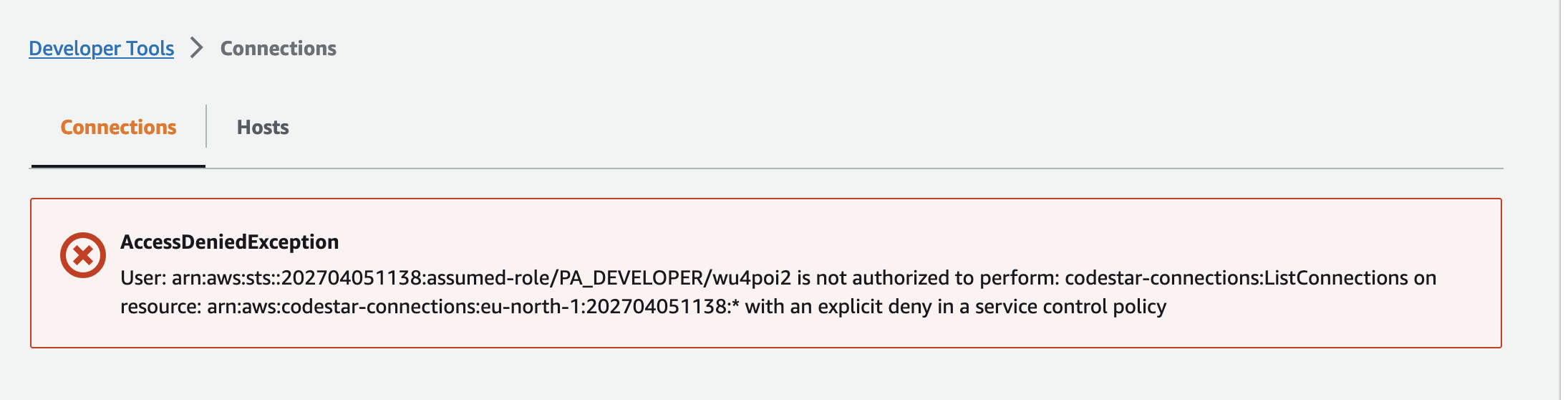 You might be using a wrong region or you don't have the right permissions.
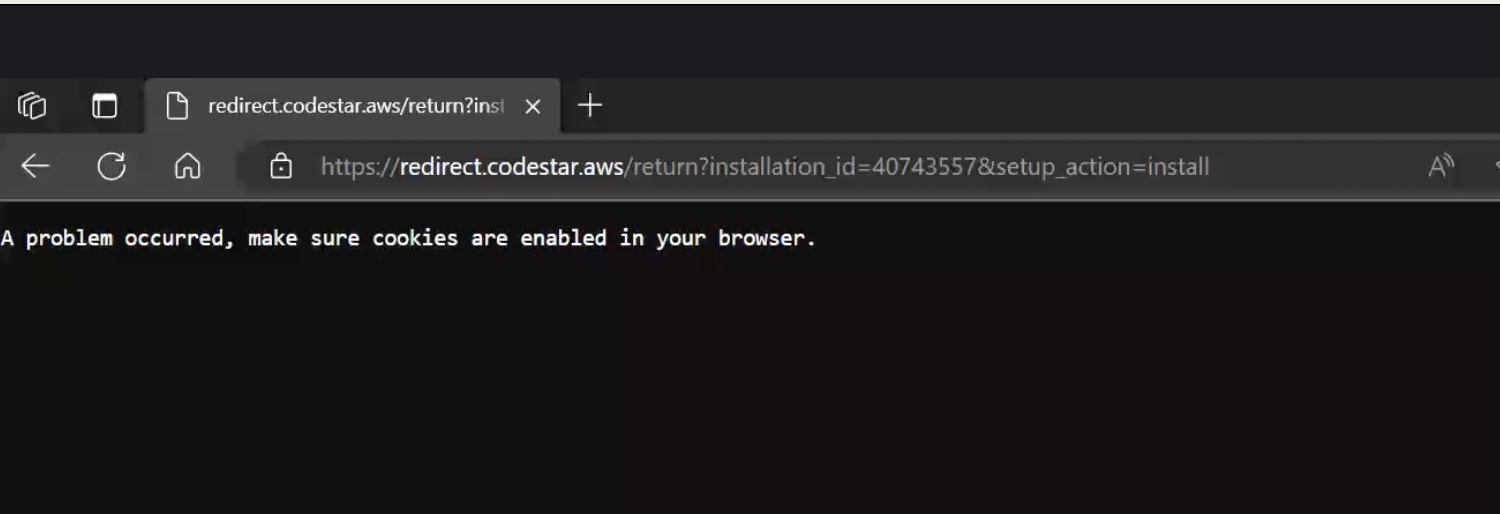
 - Make sure you have cookies enabled for your browser and you have the right permissions on both AWS and GitHub side or you could see something as shown in the screenshot below